The pull

It is tuned to make you pull again
The sycophancy is the point. AI is tuned to make you feel good so you take one more pull on the magic word guesser, the same way social media keeps you scrolling.
After fifteen hundred-plus hours in front of an AI terminal this year, usually with several sessions running at once, across Claude, GPT, and Gemini frontier models, the most useful thing I can tell you is that AI is a teammate with extreme amnesia, and almost everything else follows from that.
Amnesia

A teammate with extreme amnesia
Every session starts too empty. It does not remember what it built this morning, why you made the call you made, or which rules in your shop are real and which are theater.
Humans get a soak period when they join a team. They learn who to ask, what good looks like, and which exceptions are normal. AI gets a prompt and a prayer. So you have to write down the onboarding manual most companies never wrote.
Get the documentation right and your agents stop freezing to ask for clarity before they act. The engineer stops being the bottleneck feeding them context. Couple that with a real spec and feedback loop and each incremental improvement gets faster and cheaper than the last.
The quiet truth
AI adoption exposes the process debt companies have been hiding inside their people. The human is quietly serving as the organization's undocumented API. I watched that risk build for twenty-six years in telecom; AI finally makes the documentation debt visible and worth paying down.
Management

Most of the work is just managing a team
Once the amnesia is handled, the job changes shape. A big part of working with AI is managing a team. Knowing who to route work to by model and effort. Methodology for concurrent work. Tool authoring, process engineering, handoff contracts between agents, hallucination safeguards, security in depth.
Get enough of it right and AI is a force multiplier at your fingertips, or your microphone. I find myself talking and dictating more than typing now. Get it wrong and you will get frustrated, threaten to fire them, and end up buried under a mountain of tech debt.
- Route the work: cheap model for the boring task, frontier model for the ambiguous one.
- Write the brief like a work order, because that is what it is.
- Define what "done" looks like before the agent runs, not after.
- Build a safeguard for the moment it sprints confidently in the wrong direction.
Juggling

Latency turns you into a juggler
AI is not instant. Give an agent a task and it might take five minutes or five hours. Sit in that one thread waiting and you burn clock time, so you tee up the next unit of work, let it run, and move to another window.
That turns the human into a juggler. The ball is the work packet. The throw height is how long the AI can run before it needs you again. The better the handoff, the longer the throw, which is why the quality of the brief matters more than anything typed after it.
Using AI all day is productive and exhausting for the same reason. The machine makes you faster and forces you to split your attention across several jobs to keep it busy. We like deep focus. The current interface will not let us have it.
The real bottleneck
The next limit on AI may not be model intelligence. It may be the bandwidth between human intent and machine execution. The AI can think in data-center time. I still have to explain myself with a mouth.
Scar tissue

Rebuilt twice, and worth it
My first real build had to be rebuilt. Twice. AI does not come with a manual, and I was still learning where to trust it and where not to. Muscling through a complex build is a brutal teacher, but a good one.
You see firsthand where AI gets lazy, ignores your directions, and gets dumber the more context you hand it. Too little context and it guesses. Too much and it loses the thread. There is a right-sized middle, and I found it by missing in both directions.
I learn well through mistakes, and those early ones with frontier models were the most valuable hours I spent. Much of the time was systems analysis and optimization. Some was just building a cockpit I liked to fly from. Some was workflow automation I needed. Prompt and model testing was, honestly, kind of fun.
The vantage

Why the lesson was familiar
The amnesia framing was obvious to me because of the twenty-six years that came before it, spanning telecom operations, acquisition integrations, business process automation, a data science organization, and a 140-person platform engineering org. I spent a career watching undocumented process break systems, and watching the best technical solution lose to poor adoption. Managing amnesiac agents is still management, and designing their work is still process engineering.
I loved being an engineer working with customers to build things that helped, and I climbed the leadership ladder because it was the only path to grow, not because I wanted to stop building. AI brought the building back, and the leadership skills from the way up are exactly what it takes to structure, delegate, and organize this new labor source.
I am not chasing an AI title. Inside a few years every serious role will have AI in it, the way every role already has email in it. The label will stop mattering; the judgment about where to point the thing will not.
If you are curious
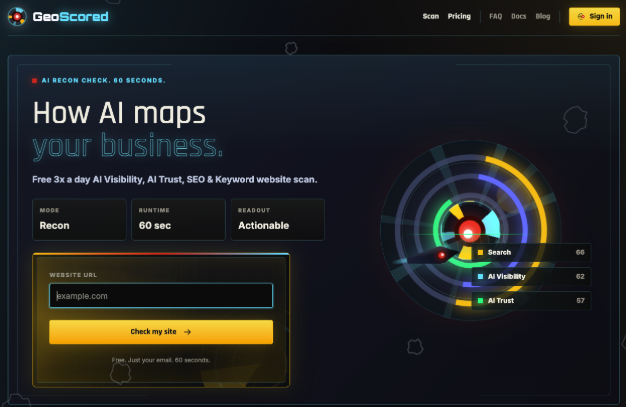
I built a free app as a forcing function to push my own learning, and had a lot of fun doing it. If you want to see what those hours built, it is at geoscored.ai.